

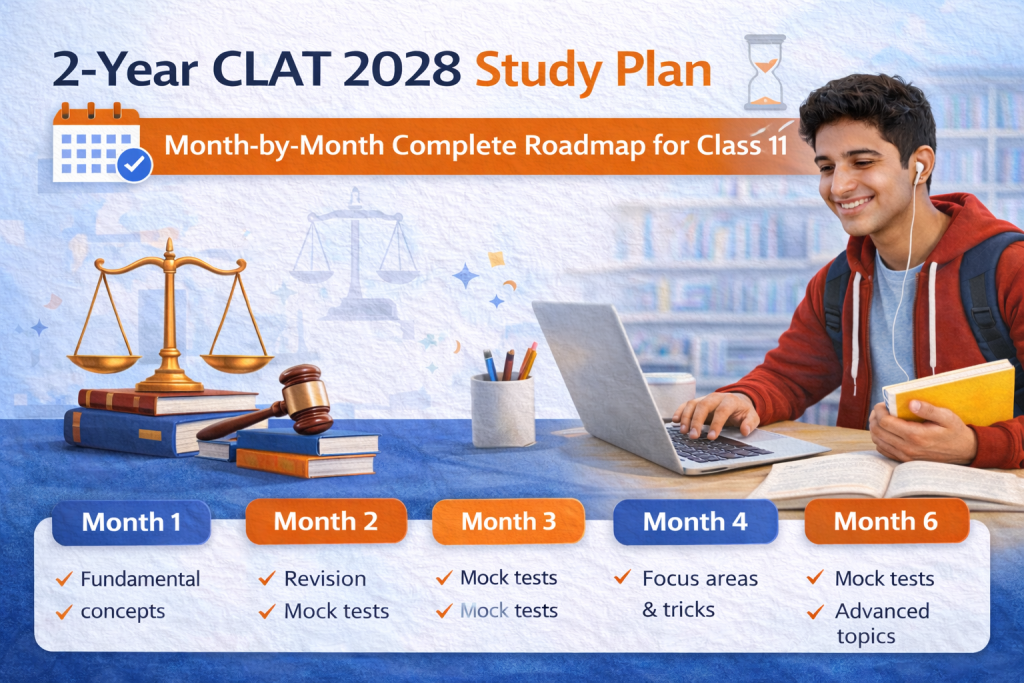
Preparing for CLAT is no longer about last-minute cramming; it’s a long-term, strategy-driven journey. With increasing competition and a comprehension-heavy exam format, starting early gives aspirants a decisive edge. Many toppers today begin their preparation in Class 11 through structured programs like CLAT online coaching, which helps them build consistency and conceptual clarity over time.
If you’re targeting CLAT 2028 and currently in Class 11, this detailed 2-year roadmap will guide you month by month, ensuring you cover the syllabus effectively while improving accuracy, speed, and confidence.
Why Does a 2-Year CLAT Preparation Strategy Work?
Starting in Class 11 gives you the luxury of time, a resource that most aspirants underestimate. A longer preparation window allows you to:
- Build strong fundamentals across all five sections
- Develop advanced reading and comprehension skills
- Practice extensively without burnout
- Continuously analyse and improve through mock tests
- Balance board exams and CLAT preparation effectively
Given that CLAT is now heavily comprehension-based, consistent reading and gradual improvement matter far more than last-minute effort.
Understanding the CLAT Exam Approach
Before diving into the study plan, it’s essential to align your preparation with the CLAT exam pattern, which defines the nature of questions and skills required.
CLAT consists of five sections:
- English Language
- Current Affairs including General Knowledge
- Legal Reasoning
- Logical Reasoning
- Quantitative Techniques
Each section is passage-based, meaning you are required to read, interpret, and answer multiple questions from a given text. This format demands:
- Strong reading comprehension
- Critical thinking ability
- Speed with accuracy
- Smart question selection
Your preparation, therefore, must focus less on memorisation and more on understanding and application.
Year 1: Class 11 (Foundation + Skill Development Phase)
The first year is about building a strong base. This phase focuses on understanding concepts, developing reading habits, and gradually introducing practice.
Month 1–2: Orientation and Habit Building
This is your starting point, where clarity and discipline matter more than intensity.
What you should focus on:
- Understanding the syllabus and exam demands
- Building a daily study routine (2–3 hours)
- Starting newspaper reading (editorials are essential)
- Beginning vocabulary building
Section-wise start:
- English: Learn basic grammar rules and contextual vocabulary
- GK: Begin maintaining a daily current affairs notebook
- Legal Reasoning: Understand what legal principles look like
- Logical Reasoning: Start with simple puzzles and arguments
- Quant: Revise basic arithmetic concepts
Build consistency, not speed.
Month 3–4: Concept Strengthening
Once your routine is stable, the focus shifts to strengthening your conceptual understanding.
Key activities:
- Solve 2–3 reading comprehension passages daily
- Practice basic legal reasoning questions
- Start sectional exercises for logical reasoning
- Continue GK notes with weekly revision
At this stage, avoid rushing into mock tests. Your aim should be clarity, not performance.
Month 5–6: Application of Concepts
Now you begin applying what you’ve learned.
What changes:
- Start sectional tests (1–2 per week)
- Focus on accuracy and understanding mistakes
- Improve reading speed gradually
Quant focus:
- Percentages, ratios, averages, and basic data interpretation
Begin analysing why you got a question wrong, that’s where real learning happens.
Month 7–8: Strengthening Weak Areas
By now, you’ll start noticing patterns in your performance.
What to do:
- Identify weak sections and dedicate extra time
- Introduce mini mock tests (every 2 weeks)
- Continue reading diverse content (legal articles, opinion pieces)
Balance all sections while improving weak areas.
Month 9–10: Introduction to Full-Length Mocks
This phase marks your transition from learning to testing.
Strategy:
- Attempt 1 mock every 2–3 weeks
- Focus more on analysis than scores
- Track time spent per section
What to learn:
- Time management
- Question selection
- Maintaining focus for 2 hours
Month 11–12: Consolidation and Stability
The final phase of Year 1 is about stabilising your preparation.
What to do:
- Attempt 2 mocks per month
- Revise GK notes from the entire year
- Strengthen the strong sections further
End of Year 1 Outcome:
- Strong conceptual clarity
- Familiarity with exam pattern
- Improved reading ability
- Basic test-taking strategy developed
Year 2: Class 12 (Advanced + Exam-Oriented Phase)
This is where your preparation becomes serious and result-driven.
Month 13–14: Acceleration Phase
With your basics in place, it’s time to increase intensity.
Plan:
- Attempt 1 mock every week
- Start timing individual sections
- Focus on improving reading speed
Tip: Begin treating mocks like actual exams.
Month 15–16: Advanced Problem Solving
Now you move to higher difficulty levels.
Focus:
- Complex reading comprehension passages
- Advanced logical reasoning sets
- Legal reasoning with tricky applications
GK Strategy:
- Start revising the monthly current affairs regularly
- Cover static GK alongside current events
Month 17–18: Performance Analysis Phase
This is a critical turning point in your preparation.
What to do:
- Increase mock frequency (2 per week)
- Maintain an error log
- Identify recurring mistakes
Focus on:
- Accuracy over attempts
- Avoiding negative marking
- Improving decision-making
Month 19–20: Intensive Mock Practice
This is your peak preparation phase.
Routine:
- 2–3 mocks per week
- Strict exam-like conditions
- Deep analysis after every test
Key skills to master:
- Question selection
- Time allocation
- Handling pressure
Month 21–22: Revision and Optimisation
Now it’s time to refine your preparation.
What to focus on:
- Revising GK thoroughly
- Practising previous year questions
- Strengthening high-scoring sections
Maximise output with minimum errors.
Month 23: Final Strategy Phase
You are now close to the exam.
What to do:
- Attempt 3 mocks per week
- Fine-tune your strategy
- Focus only on revision
Avoid experimenting with new strategies at this stage.
Month 24: Last Month Before CLAT
This phase is more about mental strength than preparation.
Key actions:
- Reduce mock frequency slightly
- Revise notes and formulas
- Maintain a calm and confident mindset
Avoid:
- Panic studying
- Overloading yourself
- Comparing scores excessively
Section-Wise Master Strategy
English Language
- Daily reading is non-negotiable
- Focus on tone, inference, and contextual vocabulary
- Practice diverse reading materials
Legal Reasoning
- Prioritise understanding principles
- Focus on application-based questions
- Avoid rote memorisation
Current Affairs & GK
- Read newspapers daily
- Revise monthly and cumulatively
- Focus on the last 12 months before the exam
Logical Reasoning
- Practice critical reasoning regularly
- Focus on arguments, assumptions, and conclusions
- Improve analytical thinking
Quantitative Techniques
- Strengthen basics first
- Practice DI sets consistently
- Focus on accuracy over speed
Common Pitfalls to Avoid
Even serious aspirants make mistakes that hinder their progress:
- Ignoring mock analysis
- Being inconsistent with preparation
- Neglecting reading practice
- Over-relying on memorisation
- Failing to revise GK regularly
Avoiding these mistakes can significantly improve your performance.
Final Thoughts
Preparing for CLAT 2028 is a marathon, not a sprint. A well-structured 2-year plan gives you the time and flexibility to build skills gradually, refine your strategy, and approach the exam with confidence.
With the right guidance, consistent effort, and a structured roadmap like the one followed by students at Law Prep Tutorial, success in CLAT becomes a realistic and achievable goal.
