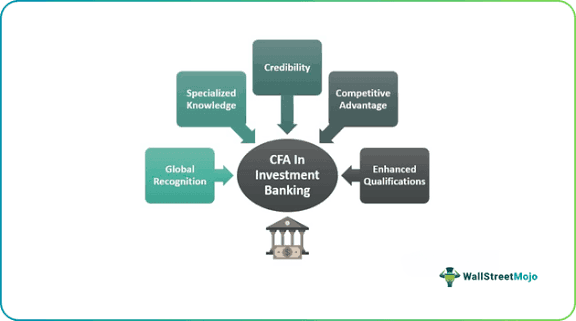

The investment banking environment demands financial expertise, deep understanding of international markets, and analytical strength – key skills that CFA course is designed to build. It is known as one of the most valued finance qualifications, equips candidates with robust knowledge in valuation, finance analysis, portfolio management, and ethics. This gives investment bankers a competitive edge in mastering core technical skills that recruiters seek for.
Beyond the technical knowledge, CFA syllabus sharpens strategic decision-making, strengthens financial modelling understanding and builds disciplined approach towards risk assessment and market research. With extensive structure and international recognition, the CFA full form (Chartered Financial Analyst) charter signals commitment, credibility, and professional excellence – traits valued in the global investment banks.
Why is the CFA Course a Powerful Asset for an Investment Banking Career?
1. Deep Mastery of Financial Analysis & Valuation
The CFA syllabus is designed around real-world financial analysis, which gives candidates foundation in interpreting financial statements, assessing organizations and determining market dynamics. Investment banking typically relies on these skills for tasks such as equity research, preparing pitchbooks, and deal analysis. The CFA full form (Chartered Financial Analyst) teaches techniques like discounted cash flow, comparable company analysis, and precedent transitions, used daily by the investment bankers.
Additionally, CFA candidates gain proficiency in quantitative methods, financial modeling concepts, and capital budgeting. These skills assist aspiring bankers to evaluate financial health of organizations, forecast future performance and build investment cases. Since investment banking interviews test analytical depth, CFA’s comprehensive syllabus gives candidates an edge.
2. Understanding of Global Regulations & Compliance
Investment banking typically operates within stringent regulatory frameworks – Basel norms, MiFID II, Dodd-Frank Act, IFRS/GAAP standards and SEBI regulations. The CFA curriculum involves major international regulatory guidelines, assisting candidates determine compliance requirements and how they influence investment decisions or capital-raising activities.
This regulatory knowledge minimizes errors, strengthens due diligence and enhances coordination with the legal teams during data execution. Banks value candidates who determine these frameworks as it shortens the learning curve and improves operational efficiency. It further ensures bankers maintain ethical and compliant standards in sensitive transactions.
3. In-Depth Understanding of Risk Management
Investment bankers must evaluate deal risks like market volatility, interest rate fluctuations, credit risk and liquidity constraints. The CFA course provides extensive understanding of risk measurement tools, involving Value at Risk (VaR), convexity, duration and scenario analysis. This enables candidates to identify and quantify risks efficiently.
In addition, the CFA program emphasizes risk-adjusted returns and hedging techniques by using derivatives. This knowledge is important when advising clients on financing decisions or pricing large-scale transactions. Investment bankers with the risk management expertise are more confident when negotiating deals and presenting recommendations to clients or senior management.
4. Enhanced Understanding of Capital Markets & Products
Investment bankers work with capital markets products like equity offerings, M&A transactions, debt issuances, leveraged buyouts, and restructuring. The CFA full form (Chartered Financial Analyst) syllabus explains mechanics of these products in detail, including pricing, financial implications, and risk assessment. This makes CFA candidates prepared for real-world IB tasks.
Candidates gain knowledge of derivatives, fixed-income instruments, alternative investments, and portfolio management. This understanding assists bankers to communicate with the institutional investors, structure complex deals and evaluate market conditions. The CFA broadens your financial vocabulary, which makes you confident in high-level IB discussions.
5. Foundation in Corporate Finance & M&A Concepts
The CFA syllabus dives into corporate finance principles like capital structure, cost of capital, working capital management, dividend policies – essential in the investment banking deals. These concepts assist analysts to determine organizations to make financing decisions, assess strategic options and plan long-term growth.
Beyond the basics, CFA course covers mergers and acquisitions, including deal structuring, post-merger integration, synergies, and valuation impacts. Since M&A is a major function of IB, CFA candidates have advantage when tackling complex transactions and contributing to deal execution.
6. Better Financial Modeling Capabilities
While the CFA program does not directly teach Excel modeling, it equips candidates with all theoretical knowledge required to build and understand models like DCFs, merger models. LBO models and sensitivity analyses. Candidates can apply these concepts directly when constructing models in investment banking roles.
The CFA full form (Chartered Financial Analyst) focuses on data interpretation, forecasting, and scenario planning improves candidate’s ability to create accurate and reliable financial models. As financial modelling is a core technical skill in IB, CFA learners find it easier to grasp modelling logic and present data-based insights during deal evaluations.
Conclusion
The CFA course strengthens your investment banking career by equipping you with deep financial expertise, practical valuation skills and ethical foundation that employers trust. It boosts your credibility and prepares you to handle complex deals, financial models, and client interactions with confidence. This makes you a competitive candidate in a demanding and fast-paced industry. Connect with the Zell Education team to learn more about the CFA program.
FAQs
1. Is CFA useful for getting into investment banking?
Yes, CFA offers robust finance fundamentals and credibility that global banks value.
2. Does CFA help with financial modeling roles in IB?
Yes, CFA strengthens analytical, financial statement and valuation skills leveraged in modelling.
3. Can CFA help me switch to investment banking from a non-finance background?
Yes, CFA builds core financial knowledge required for smooth industry transition