

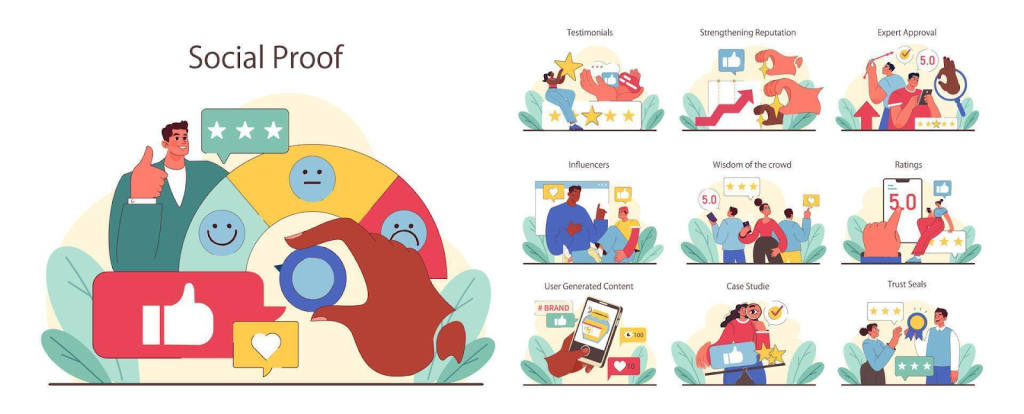
With the modern saturated digital market, there is no cheap attention or trust. Brands are not only competing based on price or quality of the product, but also on credibility. Most marketing plans fail at this point. However well-crafted your advertisements or how authoritative your copy may sound, marketing without social evidence is not successful since contemporary customers no longer believe what a brand says but trust individuals.
Social proof is the process in psychology whereby individuals look for others’ actions and thoughts to formulate their own decisions. All the reviews, endorsements, user content, influencers’ approval, case studies, and even the number of followers are considered signs of trustworthiness. The absence of these factors will not just result in reduced conversions but also make your marketing process irrelevant for a longer time period and hard to sustain growth.
Trust Is the Currency of Modern Marketing
Millions of people are bombarded with marketing messages every day. Consequently, there is skepticism at its highest. As various studies of consumer behaviour have shown, consumers are much more inclined to believe in peer-to-peer recommendations compared to brand messages. In the case of your marketing, which is not socially proven, visitors just hesitate since they cannot confirm your messages.
A good offer becomes risky without trust. A prospective client can have an attraction to your product, but doubt keeps them. Social proof eliminates that resistance by demonstrating that people have made the jump and succeeded in it.
Social Proof Reduces Decision Anxiety
The purchasing decisions are emotional rather than logical. In case users cannot see reviews, testimonials, or actual success stories, they become prone to decision anxiety. They start posing questions such as:
- Will this actually work for me?
- Is this brand legitimate?
- What if I regret this purchase?
Marketing without social proof compels the customer to provide answers to these questions on their own. Conversely, social proof offers reassurance and steers the prospects in an easy direction through the purchasing process and boosts conversion.
Algorithms Favor Proof, Not Promises
Social evidence does not simply affect individuals, but it also affects websites. Engagement, credibility, and relevance are being rewarded by social media and search engine algorithms. Reviews help to optimize local searches, testimonials of users add to the time spent on the page, and content made by users gets traffic from search engines for free.
Content without these trust signals will not be able to rank or perform well, even if it has been optimized fully. The businesses that leverage social proof will always be more likely to build a stronger groundwork of sustainable and organic exposure, which is a very good base for growth.
Social Proof Strengthens Brand Authority
Power is not a privilege, but a thing gained. Recommendations of all happy customers, certifications of industry leaders, and recorded case studies will make your brand a leader and not a new brand seeking attention.
When the prospects observe that people have trust in you, they transfer their trust to your brand subconsciously. The power minimizes the sales cycle, enhances customer loyalty, and increases lifetime value. Any marketing lacking social proof does not have this power, and each campaign will seem as if it is beginning at the bottom.
Growth Without Social Proof Is Fragile
Social proof may not be necessary to get traffic. You might even get sales. However, that growth is a weak and costly one. Ads with no trust indicators will result in poor bounces and ROI. Cold audiences need more convincing, more budget, and effort.
The social proof is a multiplier. It super-optimizes all marketing channels: SEO, paid ads, email, and social media. Marketers who value trust indicators establish a greater growth base that serves as scalability and not winning in the short term.
How to Fix the Problem
If your marketing is not performing well, first of all, check the social proof. Consider the following questions:
- Are customer reviews and testimonials emphasized to be obvious on the site?
- Are my case studies realistic?
- Do I capitalize on user-created material and user comments?
- Am I promoting alliances, accolades, or press coverage?
For example, a single customer quote or showing the verified reviews can really boost performance.
Final Thoughts
Social proof is necessary in marketing, as individuals do not purchase affirmations; they purchase trust. Social proof is no longer an option in a world where decisions are made with trust. It is the foundation of trust, sales, and long-term development. The brands that know this do not merely increase sales but rather build a stronger growth foundation, which will turn the customers into promoters and the marketing into a momentum.
